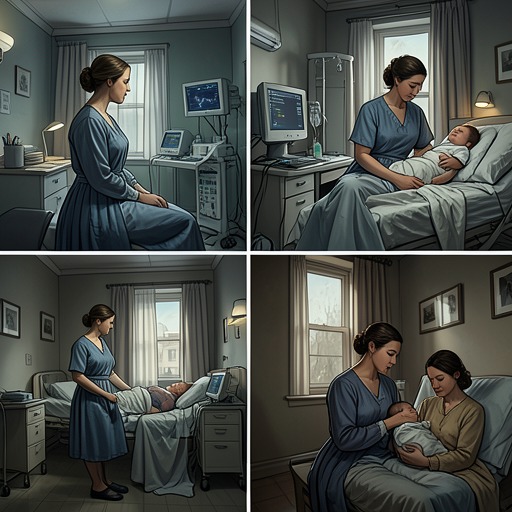
Cissie Burns
Mothering SundayCissie Burns is a young workhouse inmate whose story reveals how institutional authority can leave a girl exposed to exploitation and then punish her for its consequences. Albert Pinnegar targets her while she is approaching the age when she might be sent into domestic service; after she becomes pregnant, the workhouse sends her to Hatter’s Hall under the promise of care. Her removal, confinement, and separation from her son become a lasting injury, while Sunday Small’s testimony and Lady Lavinia Huntley’s intervention offer a way out without restoring what Cissie has lost.
Identity and life in the workhouse
Cissie is approaching fourteen when Albert Pinnegar takes an interest in her. At that age, she is nearing the customary transition from the workhouse to employment as a maid, perhaps in a town house or on a country estate. The possibility of leaving the institution for service is thus bound up with her vulnerability: Pinnegar has authority over her daily assignments before she has the independence or standing to refuse him safely.
The workhouse divides women, boys, girls, and men into separate sections, and its inmates are assigned labor according to their place in the institution. Girls and women sew uniforms, cook, clean, or work in the laundry; children also follow strict routines directed by staff. Cissie’s experience of this regime is defined less by any particular task than by her limited power within it. When Pinnegar requests her for his office, the staff can assign her there, and she is left to face his attention without effective protection.
Her friendship with Sunday Small gives her a confidante within that confined life. Sunday notices Cissie’s distress and asks after her when she returns to the dormitory. Cissie initially insists that she is all right, but Sunday sees signs that something has happened. The friendship gives Cissie someone to whom she can eventually disclose the truth, though her plea for secrecy shows how dangerous she believes disclosure could be.
Pinnegar’s attention and Cissie’s pregnancy
Pinnegar first secures access to Cissie by insisting that she clean his office. Miss Frost objects that a younger girl could do the work, but Pinnegar insists on Cissie specifically. Sunday sees Miss Frost’s unease and recognizes Pinnegar’s interest; Cissie, embarrassed and frightened, is ordered to report to him after breakfast. Sunday feels pity for her and hopes she will be able to resist his unwanted advances.
Cissie returns to the dormitory later with red eyes and a trembling lip. Miss Frost then orders her to have her hair cut. Sunday suspects that the punishment is connected to Pinnegar’s interest in Cissie, rather than to any genuine concern about her appearance. The cut does not stop him. Over the following weeks, he repeatedly calls for Cissie to clean his office, including on the pretext that its floor needs mopping. Cissie becomes increasingly withdrawn. Her distress is apparent to the other girls, but Miss Frost, who has witnessed Pinnegar’s fixation before, does not intervene effectively.
In the week before Christmas, Sunday wakes to find Cissie seriously unwell. Cissie asks the other girls not to tell anyone, fearing that speaking will make matters worse. Later, she confides to Sunday that she is going to have a baby. She understands that Pinnegar forced himself on her, though she speaks to Sunday cautiously and in the language available to her. Sunday’s later account to Lady Lavinia Huntley makes the connection explicit: Pinnegar’s repeated summons to the office preceded Cissie’s illness and pregnancy, and Cissie had been afraid to refuse him.
Removal to Hatter’s Hall
The workhouse tells Cissie that she is being sent to a pleasant place in the countryside where she will be cared for and, she believes, will be able to keep and love her baby. Instead, a carriage arrives from Hatter’s Hall asylum. Cissie recognizes it as the vehicle used to take people away to the institution and realizes that the promise has concealed her actual destination. She is terrified, and the certainty that she will be locked away leaves her no reason to trust the officials handling her removal.
When Cissie names Pinnegar as the person responsible for her pregnancy and demands that he be fetched, Miss Frost rejects her accusation and blames her instead. She claims that Cissie had been involved with male inmates, although the workhouse’s segregation rules kept male and female inmates apart. Cissie points out that the separation made the accusation implausible. The episode exposes a cruel reversal: rather than investigate the man with authority over her, the institution treats Cissie’s pregnancy as grounds to discredit and remove her.
Cissie resists being taken away. As the men sent to collect her attempt to restrain her, Sunday rushes forward and kicks one of them, briefly interrupting their effort. Sunday’s intervention cannot prevent Cissie’s removal. Later, after learning what may await Cissie at Hatter’s Hall, Sunday vows to escape with Daisy Branning and Tommy Branning and return for her. That promise turns Cissie’s disappearance into a continuing purpose for Sunday rather than a closed incident.
Confinement, rescue, and separation from her son
When Lady Lavinia Huntley visits Hatter’s Hall, she finds Cissie shackled and in a profoundly weakened state. The institution’s presentation of its daily procedures as treatment contrasts with what Lavinia witnesses and hears: a place of coercion and fear, not the promised refuge. Lavinia approaches Cissie gently and offers help. The visit is part of the intervention that eventually frees Cissie from Hatter’s Hall.
Sunday later reaches Cissie and identifies herself. At first Cissie looks blankly at her, but recognition returns. Cissie’s first disclosure is that the institution took her baby away. She breaks down in Sunday’s arms while Mrs Roundtree encourages her to cry. The reunion makes clear that Cissie’s release has not reunited her with her child: the son she had hoped to keep has already been taken from her.
After her rescue, Cissie is still painfully thin and haunted by what she has endured. Zillah washes and combs her matted hair, and Cissie is told to rest rather than return immediately to work. Although she says she is well enough to begin again, she remains troubled by nightmares. She thanks Sunday for telling Lady Lavinia about her, explaining that she had lost hope after her baby son was taken. Cissie believes she might have lost her own sense of sanity had she been forced to remain at Hatter’s Hall. She knows that Sunday is right to urge her to continue with her life, but doubts that she can ever forget those years.
Relationships and narrative significance
Sunday is Cissie’s closest source of support in the workhouse and the person who carries her account beyond its walls. Her testimony to Lady Lavinia connects Cissie’s pregnancy to Pinnegar’s conduct and recounts the deception used to send her to Hatter’s Hall. Cissie’s gratitude after her rescue confirms the practical importance of that disclosure: what the institution had kept hidden becomes something a powerful visitor can act upon.
Cissie’s relationships with Pinnegar and Miss Frost expose two forms of institutional failure. Pinnegar exploits his position to gain access to her, while Miss Frost responds to Cissie’s accusation by discrediting her and facilitating her removal. The workhouse’s division of inmates, far from assuring Cissie’s safety, also provides the framework for a false accusation that she had relations with male inmates. Her age, poverty, and dependence on the institution compound the difficulty of being heard.
Cissie’s story also gives consequence to Sunday’s later efforts to challenge workhouse abuses. The rescue restores Cissie to ordinary company and gives her a chance to recover, but the narrative does not treat freedom as a complete repair: she remains separated from her son and troubled by memories of confinement. Her survival therefore embodies both the possibility and the limits of intervention. People outside the institution can expose its practices and bring her out, but they cannot reverse the years of harm or return the child she had hoped would be her own.